When a dog is returned to a shelter, the reasons are often heartbreaking. But few are as surprising as the story of Roxxie, a five-year-old pit bull who was sent back to the Huntington County Humane Society in Indiana for being “too affectionate.” Her only fault? Wanting to snuggle in bed at night. This unusual reason for surrender captured national attention and offered a fresh look at the misunderstood nature of pit bulls, while also highlighting the deep emotional lives of shelter animals.

Roxxie had been adopted by a family who seemed, at first, to be a good match. However, just two weeks after she left the shelter, she was returned. According to Katy Hudson, board president of the Huntington County Humane Society, the adopters simply didn’t want to deal with a dog who wanted to cuddle. “Roxxie wanted to snuggle in bed at night, and they just didn’t want to deal with that,” Hudson told The Dodo. The shelter even offered to help train Roxxie to stay off the bed, but the family declined.



This reason for surrender was not only uncommon—it was deeply confusing for the shelter staff. “We’ve heard almost every reason under the sun for why animals get surrendered to us,” Hudson explained, “but for a pet to be returned for being overly affectionate and clingy is not something we’ve come across before.” I found this detail striking, not just because of its rarity, but because it speaks volumes about the expectations some people have when adopting a pet.
For Roxxie, the sudden return to shelter life was devastating. She withdrew emotionally and physically, curling up in her kennel and avoiding interaction. “She was just broken,” Hudson said. “She was not her usual happy-go-lucky self.” It was a stark contrast to the loving, sociable dog the staff had come to know.
Once Roxxie’s story was shared on the shelter’s social media, the response was overwhelming. Messages and phone calls poured in from across the country. Her story resonated with many, not only because of the emotional impact but also because it challenged stereotypes. Pit bulls are often unfairly labeled as aggressive, but Roxxie’s gentle, affectionate nature helped show that dogs of all breeds can have a wide range of personalities. As Hudson noted, “It helped to educate people that pit bulls come in all different personality styles, and it’s a spectrum, just like with every other breed.”
Among the dozens of applications the shelter received, one stood out: the Chase family from Illinois. They had recently lost their beloved dog, Lucy, and were finally ready to open their hearts again. Roxxie reminded them of Lucy, who had also loved to cuddle in bed. The Chases, who already had six rescue cats, made the three-hour drive to meet Roxxie in person.


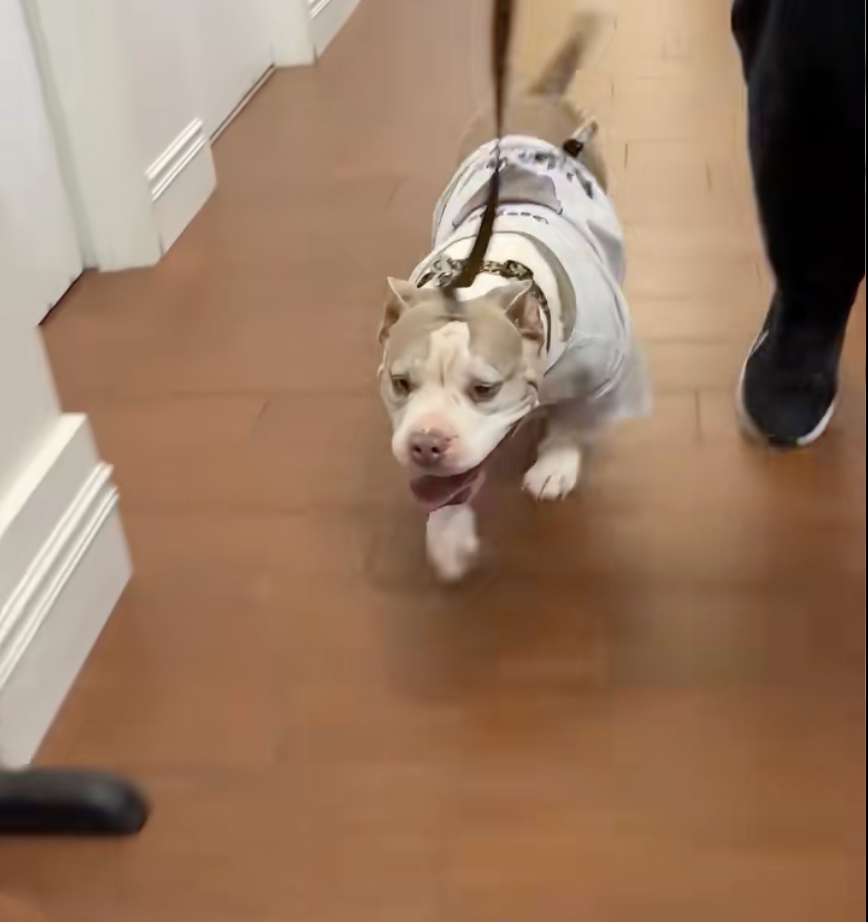
Hudson described the Chases as a family “fully invested in their animals,” and it quickly became clear that they were the right fit. The shelter even organized a special sendoff for Roxxie the next day. Staff members lined up outside to cheer her on as she trotted out the door with a big smile, ready for her new beginning. She jumped eagerly into the family’s van, revealing another one of her favorite things: car rides.
In her new home, Roxxie was given a name that reflected her fresh start and loving personality: Lady Olivia Huntington, or “Livvie” for short. Her new mom, Jessica Chase, shared that the first thing Livvie did when she arrived was hop onto the bed and snuggle—exactly the behavior that led to her being returned. But this time, it was welcomed with open arms. “I don’t think a dog can be too affectionate,” Chase said. “I love how much she loves us.”
Livvie quickly bonded with the entire family, especially the Chases’ 12-year-old twin daughters, Annaliese and Kirsten. She now greets them at the door each day after school, ready to play and cuddle. “They come in and snuggle with her, and she licks them, and they giggle. It’s really sweet,” Chase shared.
For Livvie, the transition from heartbreak to happiness was swift and profound. She now sleeps peacefully with her new family each night, her affectionate nature no longer seen as a flaw but as one of her most endearing qualities. Her story didn’t just change her own life—it had a ripple effect. According to Hudson, fifteen other dogs were adopted from the shelter thanks to the attention Livvie’s story received.


This uplifting story serves as a reminder that affectionate shelter dogs like Livvie have so much love to give. For those seeking a loyal, loving companion, shelters remain a powerful place to find not just a pet, but a new family member. As Hudson put it, “There are lots of affectionate shelter dogs who have so much love to give.”